


Ambassador on business opportunities with Greece: Greece and Lithuania can offer to each other much more than feta cheese and tourists
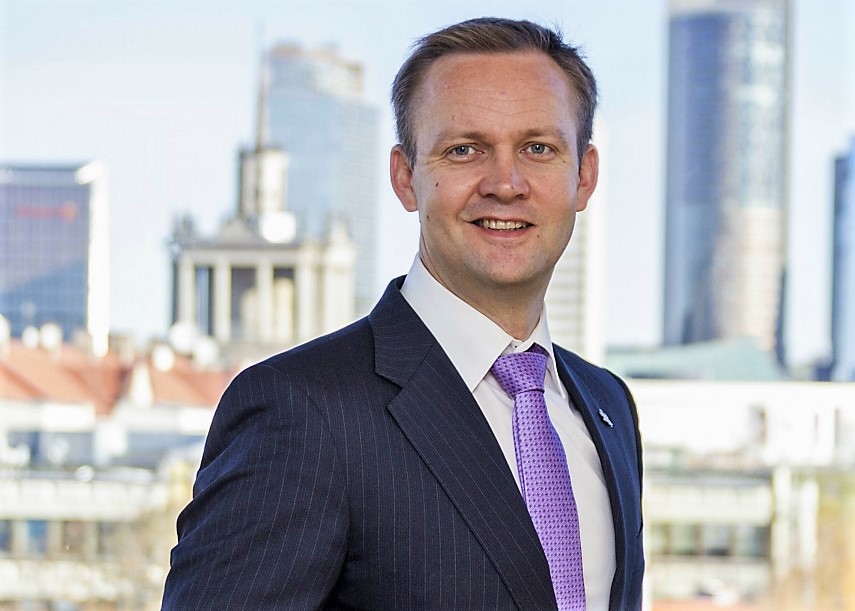
In view of the first Greek business delegation to Lithuania, Ambassador Rolandas Kačinskas gave interview to the Newsletter of Hellenic Federation of Enterprises about business opportunities with Greece. How important is economic diplomacy in global affairs? What is Lithuania’s approach? Economic diplomacy has always been an important and integral part of diplomacy, and its significance has grown even more recently. I can think of two reasons for this tendency: first, the acceleration of globalization processes, and secondly, the blurred border between foreign and domestic politics. In the first case, the globalization has made the power in international relations to move from the political and military space to the economic one, and in the second case, the changing nature of diplomacy have raised citizens' demands for diplomacy and from diplomats, requiring them to contribute to the issues of economic prosperity and welfare of the society. These two trends influence Lithuania's approach to economic diplomacy accordingly. Lithuania’s diplomacy is tasked today to be an active and creative one in helping the country to integrate into the global structures, in particular by ensuring transport connectivity, energy independence, and rule based trade. It is also expected to focus on country promotion, new market openings, investment attraction and last, but not least, building bridges with different countries, in this case –between Lithuania and Greece.
What kind of opportunities are there in Lithuania that Greek exporters and businessmen would find particularly interesting? What are the future development plans and prospects that they should keep in mind?
Let me start by saying that Greece and Lithuania can offer to each other much more than feta cheese and tourists. The problem is that both ourcountries suffer from a certain lack of knowledge of each other capabilities and stereotypes. Lithuania is often seen in Greece as an emerging economy with a small marker and limited business opportunities. But did you know that Lithuania, being at least three times smaller than Greece, is not that far behind Greece in terms of exports? In fact, with €33.4 bn and €28.4 bn, Greece and Lithuania share 20th and 21st positions among EU member-states according to the value of their exports. Moreover, Lithuania’s export is equal to the combined exports of Estonia and Latvia. These impressive numbers of export translate into positive effect on the country’s employment and income, and, in turn, on consumption. Latest data, released by Eurostat, shows that a measure of material welfare of households, also known as an Actual Individual Consumption (AIC) per capita expressed in Purchasing Power Standards (PPS) for Lithuania were only 10 % less below the EU average. As the export continue to grow ( 16.9 % in 2017 and 7.3% in 2018) and the economy to expand (by 3.9 % in 2017 and 3.6 % in 2018 ), as the country continues to climb in the rankings of Doing Business Indicator (now being among top 20 of 190 countries in the world), all this is the proof that Lithuania has a rather big business potential, including for Greek investors and exporters. Therefore, I would say that this is the first thing that the Greek business should keep in mind.
Secondly, the Greek business should be aware that Lithuania is a rapidly changing country, with transformation and progress being measured in months rather than years. The structure of the Lithuanian economy is shifting towards high added-value production. The sectors in whichit is excelling include ICT, life sciences, electronic and laser industries. Here are just some facts: Lithuania has the largest ICT industry in the Baltic States with an outstanding potential both for local as well as foreign expanding businesses; Lithuania’s life science sector is the fastest growing in the EU (annual growth reaches 25 %); Lithuania accounts for more than half of the global market of pico-second laser spectrometers, andwith 10% of the global market, Lithuania is one of the main exporters of femtosecond lasers systems in the world; Lithuania is emerging fast as a key electronic manufacturing hub in the Baltic region, especially focusing on electronic, computer and optical products.
At the same time, more traditional sectors such as textile, furniture and food are not forgotten too. But once again, in effort to develop products with higher added value, Lithuanian companies are not standing still, constantly renewing and looking for niches in the world market. For instance, in textile and clothing industry, Lithuanian companies are actively investing in creating unique brands and contemporary design, yet with a touch of traditional materials such as wool or linen. In furniture and wood processing industry, Lithuanian companies are already picking the fruits of extensive modernization an innovation, which allowed them to improve production capacity and move from crafts to individuals to modern mass production, accordingly making Lithuania the fifth biggest IKEA supplier in the world. In food sector, Lithuanian companies take up the niche of production, based on the motto “fresh, green and natural”.
Finally, several large-scale infrastructural development plans currently underway in Lithuania might be of special interest to the Greek business as well. By far largest of them is the implementation of the Rail Baltica project with the aim to build the 729 kilometres long railway which would finally connect the three Baltic States to Poland in a direct link, and further on to central European railway networks.Worth of approximately €6 bn, not only it is the largest infrastructure project in the Baltic area in over a century, but it also will create many business opportunities in the coming years both in terms of the railway itself, but also other related infrastructure projects. The fact that this is true is illustrated by the recent success of a Spanish engineering company which won this June one of the first contracts handed out in connection with the Rail Baltica project. So,I invite the Greek business to be active and participate in tenders run by RB Rail as well.
Other infrastructure projects worth noticing are the synchronization of the Baltic states’ power grids and expansion of Lithuania’s only sea port of Klaipėda, however, Greek-Lithuanian cooperation should not be limited to large-scale infrastructure only. Lithuanian larger cities and smaller towns are renewing themselves and implementing many interesting projects, whether they are related to providing sustainable transport solutions, construction of public logistic centers or building sports and cultural complexes, that can really interest Greek construction, engineering or architecture business.
What are the lessons that Lithuanian and Greek business communities can learn from each other?
Lithuanian business is a reflection of the success of Lithuania as a whole, so let me answer this question from a state perspective.
First, others could learn from Lithuania how to use the window of opportunity. Being a small country, we cannot influence the structural elements, but we can, with the patient work, preparation and lots of hope, take advantage of the emerging opportunities and then not let them go. Consider the example of Lithuania: no one believed too much in the world that we can gain independence, build successful democracy and thriving economy, join the EU and NATO, but we were determined to use the slightest opening of the window opportunity to achieve our goals. Lithuanian business has acted similarly. Starting from scratch, it used every possibility to find the niches for growth. And it continues to do so. It is no coincidence that Lithuania is known today for its start-ups. Actually, thirty years ago when we proclaimed the restoration of our independence, Lithuania itself was a startup nation. Currently there are more than 600 start-ups in Lithuania. In recent years, the number of start-ups has increased by 47 percent, and the Ministry of Economy and Innovation of the country has set a goal to increase the number of start-ups in Lithuania to 1,000 by 2020.
But to use α window of opportunity, one must be ready. This is a second lesson. It should be kept in mind that we are talking about a process that never ends. There is a need for constant exercise to maintain the best forms. Growth momentum and competitiveness can be lost very quickly. Once you abandon or stop the reforms, stop thinking about the future, stop being conscious or critical to yourself, start accepting the present as a granted thing, then you will eventually lose.
Lithuanian business, like the rest of the country, has consistently worked and continues to work tirelessly for the future, to move forward, focus on innovation and technological advancement.
Finally, one more lesson, somewhat related to the two previous ones, can be offered. Due to the painful historical experience and geopolitical circumstances, Lithuanians now realize that we must be successful. We simply have no choice but to be successful. Being semi-successful is not an option for Lithuania. Not an option because sooner or later we would be condemned to fail. But to be successful means that we must work tirelessly to get ready to use the window of opportunity when it arrives.
As for the question what we can learn from the Greek business community, the first thing that comes to mind is that we could learn an openness to the world and strategy how to achieve domination in the wider region as the Greek business has achieved one in the Mediterranean region, by turning the country into a regional hub for European and American multinationals.
Our two countries held the Presidency of the EU Council consecutively in 2013-2014, and it will be so again in 2027. What is your vision for Europe 2027 and beyond?
It is quite a fortune that Lithuanian and Greek presidencies of the EU Council follow each other as it provides an opportunity to reflect in one year the needs of European citizens from a wider Europe perspective as well as to overcome perceived South-North division. The cultural, social and political diversity of North and South Europe must be associated not with the differences but with the strength of the EU.
Speaking in general terms, I would say that Greece and Lithuania share similar vision for Europe. Both our countries want to strengthen European project by bringing more solidarity, unity, and cohesion. Being on the frontlines of the EU and NATO, we also want more security and better protection of our external borders. Finally, both our countries make efforts to establish a stable, strong neighborhood with strong links with Europe. This clearly shows that we are all in the same boat, although on different sides of it. Therefore, our unity and harmonious actions in rowing this boat is indispensable if we want to move forward.
Speaking on issues that are more important to business community, Lithuania is of position that EU strategic agenda should address those strategic priorities, which deals with innovation and digitalization of Europe; further deepening of the Single Market in all its dimensions, including services; robust convergence of Member States using all available EU policy tools, such as Cohesion funds; connectivity, by developing strategic EU projects of transport and energy networks.
Having listed those objectives, we should also not forget social needs for future of Europe, and think about how to reduce inequality, poverty and social exclusion
How can the European business community contribute to this vision?
It seems that businesses, while participating in sector-specific policies that affect them on a daily basis, have a tendency on staying in sidelines of a larger debate on the future of Europe. Considering the possible impact of growing uncertainty in Europe, business - with the rest of civil society -should get involved in the debate and decisions more actively. Important to understand that we face a very crucial time, debate is not merely bureaucratic - it deals with the very notion of Europe. A strong, united and reliable EU is not a lofty slogan, it is a business case. So, get involved!


